Weather Data Streams Reshaping Live Football Odds for Central European Bookmakers
Lars Fischer · Aug 26, 2026

Weather Data Streams Reshaping Live Football Odds for Central European Bookmakers
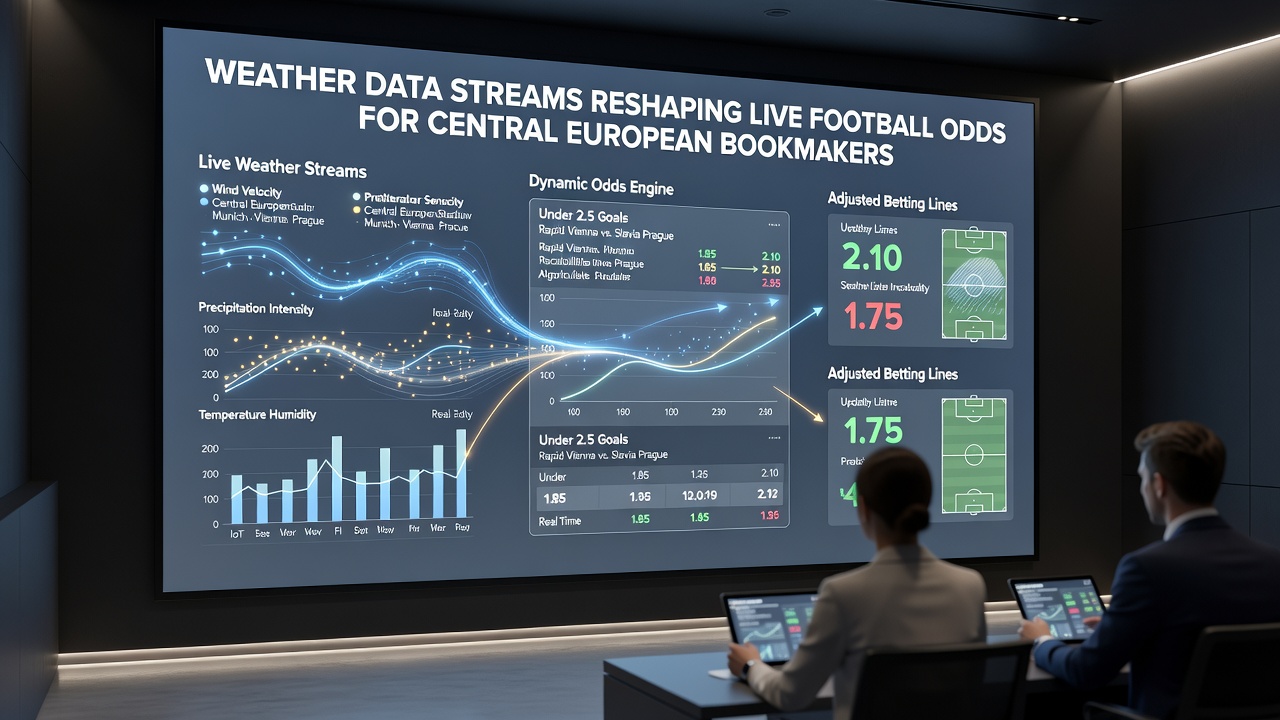
Weather conditions influence football matches in measurable ways, and Central European bookmakers have integrated real-time data streams to adjust live odds accordingly. Rain reduces ball speed and increases slip risk for players, while strong winds alter trajectory on long passes and shots, and temperature swings affect player endurance during extended play. These factors feed directly into algorithms that recalculate probabilities second by second during matches in leagues such as the Bundesliga and Swiss Super League.
Weather Variables and Match Dynamics
Precipitation levels above 5 millimeters per hour correlate with fewer total goals across multiple seasons, according to aggregated match statistics compiled by European sports analytics groups. High humidity combined with temperatures exceeding 28 degrees Celsius leads to measurable drops in sprint frequency after the 70-minute mark, which in turn shifts expected goal models used by oddsmakers. Wind speeds over 30 kilometers per hour introduce variance in set-piece outcomes, prompting operators to widen margins on corner and free-kick markets during live play.
Integration of Live Data Feeds
Bookmakers source granular weather inputs from satellite networks and ground sensors that update every minute, allowing systems to modify implied probabilities without manual intervention. Central European operators connect these streams to existing trading platforms so that odds on over/under goals or next-team-to-score respond instantly when forecasts shift mid-match. One documented implementation at a Vienna-based firm showed live adjustments occurring within 45 seconds of a weather data update during a 2025 Austrian Bundesliga fixture played under sudden heavy rain.
Regional Adoption Patterns
Operators in Germany, Austria, and Switzerland adopted these systems earlier than many Southern European counterparts because variable alpine weather creates more frequent in-game shifts. Data from the European Centre for Medium-Range Weather Forecasts shows that Central European matches experience weather changes during play roughly 18 percent more often than fixtures in Mediterranean climates. This frequency justifies the infrastructure investment required to maintain low-latency feeds and has produced tighter spreads on weather-sensitive markets such as total corners and player performance props.
August 2026 Outlook
By August 2026, several providers plan to layer micro-climate modeling onto existing feeds, using localized radar to predict rain bands that will reach specific stadium sections within 10 minutes. Such granularity may further refine odds on individual player bookings or substitutions triggered by fatigue in sudden downpours. Regulatory filings submitted to Swiss and German authorities indicate that at least four major Central European platforms intend to test these enhanced models during pre-season friendlies scheduled for that month.
Technical Infrastructure Requirements
Maintaining sub-second latency demands dedicated API connections and redundant data centers located near major betting hubs in Frankfurt and Zurich. Bookmakers also maintain fallback protocols that revert to historical averages if sensor networks experience outages, preventing erroneous odds from reaching customers. Industry reports compiled by the European Gaming and Betting Association note that firms investing in dual-source weather verification reduced pricing errors by 22 percent over a 12-month test period ending in early 2026.
Conclusion
Weather data streams now form a core component of live odds engines operated by Central European bookmakers, supplying continuous inputs that alter probabilities across multiple markets. As modeling techniques advance through 2026, the precision of these adjustments will continue to depend on the quality and speed of meteorological sources feeding the systems.